
Main Content
HAU and Global Partners Collaborate to Reform Veterinary Curriculum for AMR Prevention
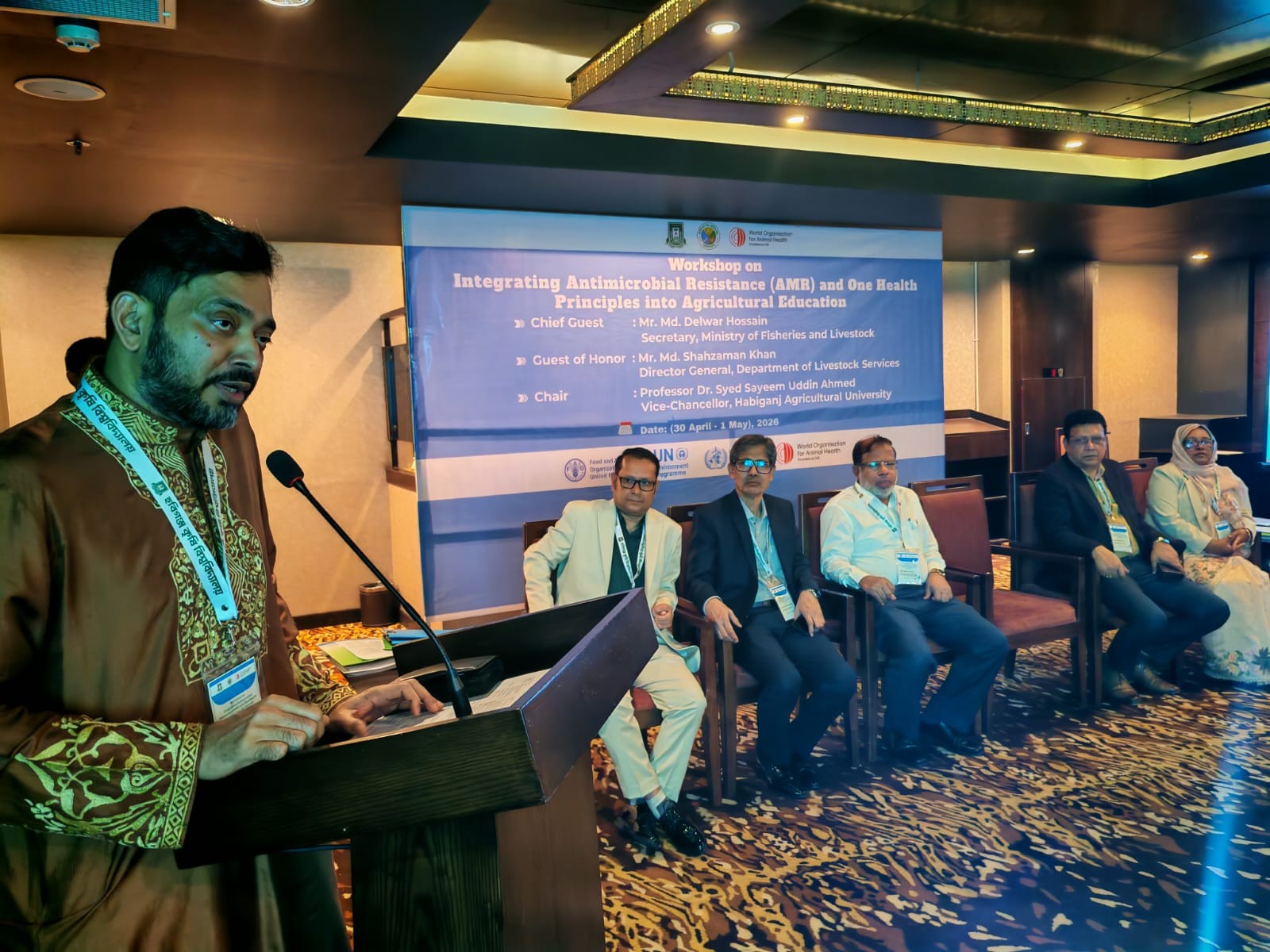
HAU and Global Partners Collaborate to Reform Veterinary Curriculum for
AMR Prevention
A two-day workshop was inaugurated on Thursday (April 30) at ‘The Palace Luxury Resort’ located in
Putijuri, Bahuball, Habiganj to address the growing global threat of Antimicrobial Resistance (AMR),
organized by Habiganj Agricultural University (HAU), Department of Livestock (DLS) and World
Organization for Animal Health (WOAH).
The inaugural ceremony was presided over by Honorable Vice Chancellor of Habiganj Agricultural
University, Professor Dr. Syed Sayem Uddin Ahmed, Secretary of the Ministry of Fisheries and
Livestock Md. Delwar Hossain was present as the chief guest, and Director General of the Department of
Livestock Md. Shahzaman Khan spoke as the special guest.
The event was attended by top officials from the World Health Organization (WHO), Food and
Agriculture Organization (FAO), United Nations Development Program (UNDP), Bangladesh Livestock
Research Institute (BLRI) and respected teachers of the Faculty of Veterinary Medicine and Animal
Science of Habiganj Agricultural University, Habiganj.
The discussants in the workshop mentioned that education on antimicrobial resistance in the country is
still mainly limited to the theoretical level. To overcome this situation, emphasis was placed on practical
and skill-based education for veterinary graduates. To this end, the need for reforming the existing
curriculum of Habiganj Agricultural University was highlighted. Special emphasis was given to the
effective implementation of ‘Antimicrobial Stewardship’ and the interdisciplinary ‘One Health’ policy.
The main objectives of the two-day workshop include aligning the current curriculum of the university
with the global AMR framework, identifying gaps and priority areas related to AMR and 'One Health' in
the curriculum, developing new modules for veterinary education based on modern teaching methods, and
formulating an effective roadmap for the institutional approval of these modules and their inclusion in the
academic framework. The organizers hope that this workshop will strengthen coordination among the
relevant stakeholders and lay a solid foundation for building sustainable and effective antimicrobial
resistance prevention management.


